ElevenLabs says voice wins long conversations. Read the latency data instead
A vendor study published on 2 November says voice agents beat chat on long conversations, but its duration buckets are shaky and its latency finding is the part a team shipping voice agents should act on.
- Written by
- Baraqix Engineering
- Published
- Read
- 5 min
- Filed under
- voice, latency, evaluation
Contents4 sections
On 2 November, ElevenLabs published a study comparing voice and chat agents, and updated it on 3 November. The headline claim is that in conversations longer than two minutes, voice succeeded 32% more often than text chat. It is a vendor study about its own product category. We think the headline is the weakest number in the post, and the latency finding is the one a team shipping voice agents should act on.
What the post reports
The comparison covers voice calls over the phone and WhatsApp against chat sessions, across what the post calls hundreds of production agents that run both channels. The methodology section says it included agents with at least 50 voice and 50 chat conversations between July and September 2026, each judged against success criteria the business defined for its own use case. Each agent was compared against itself rather than pooling all traffic.
- Under one minute, chat did better by about 9 percentage points. Between one and two minutes, the channels were fairly even.
- Past two minutes, voice success rates were 10.9 points higher, which the post states as a 31.7% increase (rounded to 32% in its summary), and nearly two thirds of agents did meaningfully better on voice.
- Among successful conversations over two minutes, voice averaged 4.6 minutes against 7 for chat, and 78% of the 90 agents with enough successful long conversations on both channels resolved them faster on voice.
- Across what the post describes as 315 agent conversations that switched to a faster LLM, a 16% reduction in average end to end latency correlated with a 26% lift in success rate. The share of calls ending within 15 seconds fell from 21.1% to 3.8%.
- In a separate user study, 98 participants rebooked a simulated canceled flight with both a voice agent and a chat agent in randomized order, and 85% said afterwards that they preferred voice.
Why we would not pick a channel from this
The per agent comparison is a good design choice, and we would copy it. It removes the obvious trap where one business with high success rates and mostly voice traffic makes the whole channel look good. The problem sits one step later, in the duration buckets.
The post uses conversation length as a stand in for complexity, and it says itself that duration is an imperfect measure, especially for chat, where customers pause between messages. A chat that runs past two minutes and a call that runs past two minutes are not the same population. A slow typist with a simple question lands in the long chat bucket. Duration is also partly an outcome of the conversation, so splitting on it means partly splitting on how the conversation went. The post does not publish how traffic is distributed across the buckets for each channel, so a reader cannot tell how much of the 10.9 point gap comes from which conversations land where.
Two more gaps. The post does not say whether an agent's voice and chat channels were judged against identical success criteria. And the 85% figure is a stated preference after a simulated scenario, in a study run by the vendor. None of this makes the result wrong. It makes it a hypothesis to test on your own traffic, not a reason to move budget.
The latency number is the useful one
The latency finding is also correlational, and switching to a faster model can change answer quality as well as speed. But the mechanism the post proposes is concrete and easy to check: latency matters most at the start of a call, when people decide whether to stay on the line, and callers who wait too long assume the line is dead and hang up. A fall in calls ending within 15 seconds from 21.1% to 3.8% is visible in your own call records within a day.
That matches how we think about phone agents on Twilio: much of what decides whether a voice agent succeeds happens before any reasoning does. Every stage between the caller finishing a sentence and the first audio reaching them adds up: end of speech detection, transcription, the model call, the first text to speech chunk, and the media stream back. A team that only tracks average model latency is measuring one stage out of five.
What we would log
| Metric | Why it matters |
|---|---|
| Time from end of caller speech to first audio, per turn | The delay callers actually feel. Track p50 and p95, not the mean. |
| Share of calls ending within 15 seconds | The early abandonment signal the post highlights, and cheap to compute from call records. |
| Turns per resolved conversation, per channel | A better complexity proxy than wall clock duration, because it ignores typing pauses. |
| Outcome against one shared definition | The same success rule for voice and chat, written down before you compare them. |
| Model and prompt version per conversation | Without it you cannot attribute a change in any metric above. |
The early hangup metric is a plain query. A sketch for PostgreSQL, assuming a calls table with one row per conversation:
SELECT agent_id,
       channel,
       count(*) AS conversations,
       round(100.0 * avg((duration_s < 15)::int), 1) AS pct_under_15s,
       round(100.0 * avg(succeeded::int), 1)         AS pct_success
FROM calls
WHERE started_at >= now() - interval '30 days'
GROUP BY agent_id, channel
HAVING count(*) >= 50
ORDER BY agent_id, channel;
The HAVING clause mirrors the post's floor of 50 conversations per channel. Compare each agent against itself and change one thing at a time.
What we would do
- Set a budget for time to first audio per turn, and treat a regression against it as a failed release, the same way a backend team treats a broken API contract.
- Before arguing about channels, instrument both with the same outcome definition and a turn count, then read the results per agent.
- When the model is the slow stage, test a faster model on the opening turns, where the post suggests latency matters most, and keep the stronger model for turns that need it. Measure whether success moves, not only latency.
- Make sure the voice agent can finish the job. The post makes this point as well: long conversations need context and connections to real systems, otherwise the caller gets handed off and the channel comparison stops mattering.
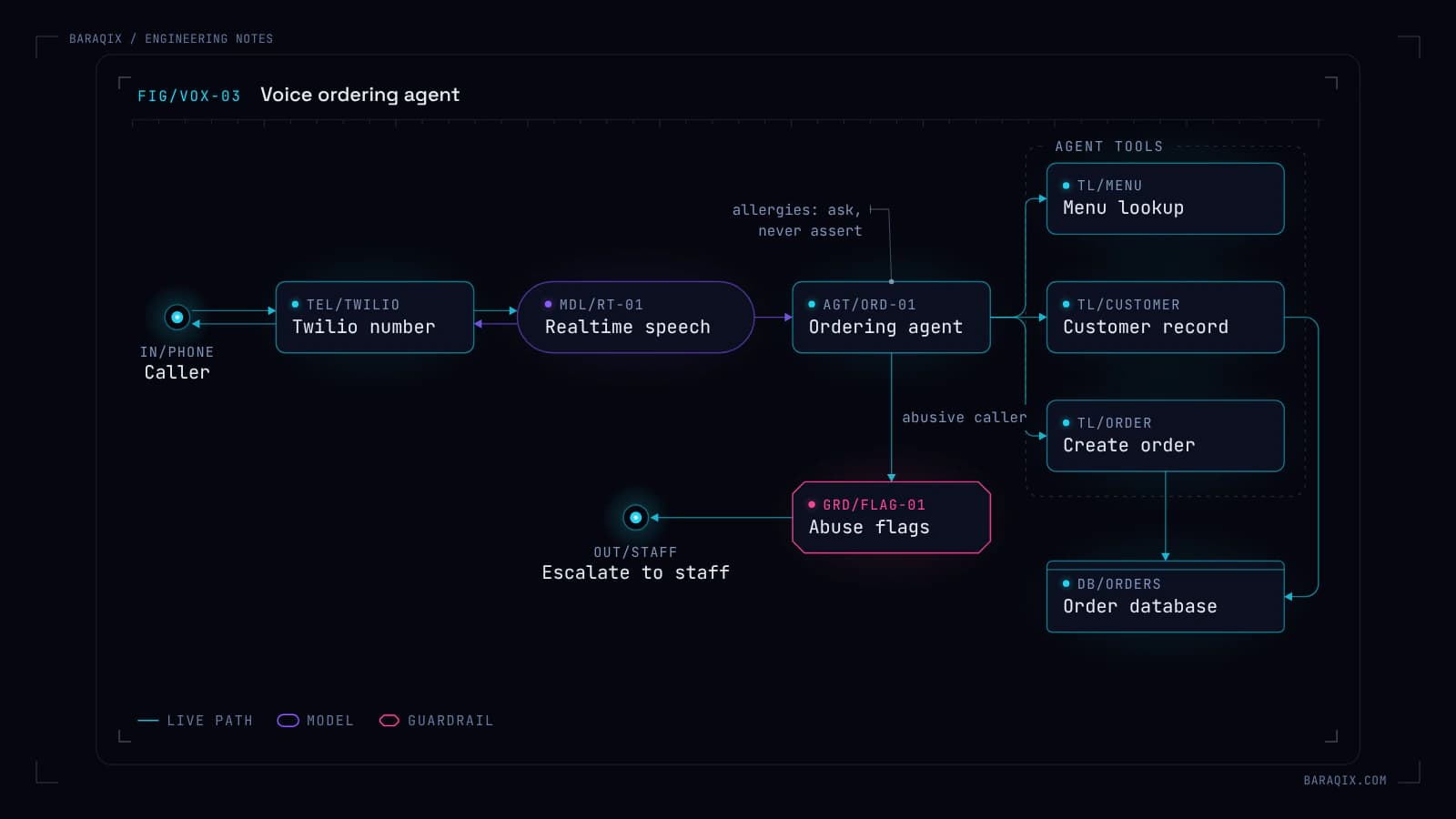
Our phone ordering agent for restaurants is at demo stage, so we have no production success rates to set next to these numbers, and we will not write as if we did. What we can say is where we would start: the first fifteen seconds of a call and the time to first audio, measured per turn. If you are planning a voice agent on Twilio, or deciding whether one belongs next to an existing chat assistant, that is the scope of our voice agent work, and a Discovery Sprint is where we would measure it on your traffic before building anything else.
Baraqix Engineering. Written by the engineers who did the work.
NOTE/08. First published .